Solve continual learning by building the environment that forces it.
Continual MI is a research and product company aimed at continual machine intelligence — models that keep operating, keep adapting, and keep learning instead of resetting at the edge of a context window. The work runs across three product surfaces — MDL, MGPT, and EMWaver — that fit together as one long-horizon plan.
Continual learning is the bottleneck. The fastest way through it is an environment that demands it.
Today's frontier models are powerful but fundamentally episodic. They solve tasks within a context window and then forget. Real intelligence — the kind that eventually operates in the world — has to keep going.
We believe the most direct path is to build an environment that simply does not allow models to stop learning. An endless world with persistent state, persistent characters, and a horizon longer than any model's context. From there, evaluation, data, and architecture all become tractable, because the environment itself rewards the property we care about.
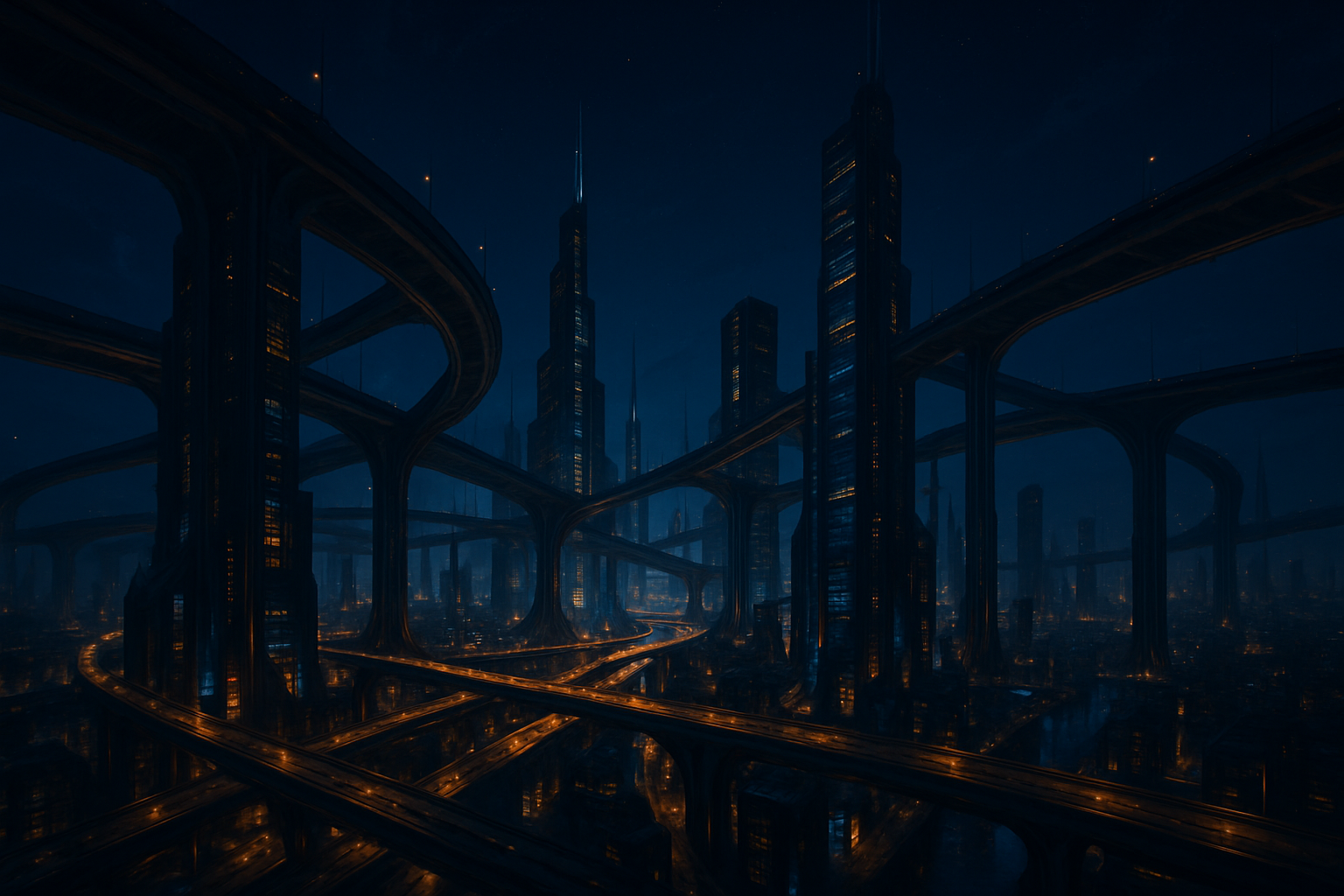
That environment is MDL. The architecture that grows out of it is MGPT. The physical extension of both is EMWaver. The end state is the Continual Megapolis.
Five phases, one through-line.
- Phase 1 · Environment
MDL — an environment that forces continual learning.
MDL is an endless visual novel engine. By construction, an endless visual novel demands continual learning from any model that operates inside it: the world keeps going, characters persist, state grows, and there is no fixed-context exit. We use MDL as the environment that forces continual operation and as the data surface from which we collect long-horizon training signal.
- Phase 2 · Architecture
MGPT — a stateful successor to GPT.
Evaluation for continual learning is and will remain hard. The MDL environment lets us evaluate honestly inside it and generate the data needed to train new architectures. MGPT is our first such architecture: a stateful large language model designed to keep operating instead of failing at fixed context limits.
- Phase 3 · Flywheel
Models that improve the game, players that improve the models.
Once MGPT runs the worlds, we train it to make the games better. Better games bring more players. More players generate more long-horizon interaction data. That data trains the next round of models. The environment, the players, and the architecture compound on each other.
- Phase 4 · Bridge
From virtual AI to physical AI.
We believe an architecture that genuinely contains continual learning can adapt to any domain — including ones it was never trained on. That is what continual learning means. So we are deliberately connecting two domains that look unrelated: simulated game worlds and the physical world. EMWaver is the bridge: a local-first, open-source electronics platform that lets the same agents operate sensors, actuators, and embedded systems directly.
- Phase 5 · Continual Megapolis
Cities that build themselves.
We do not believe a competent machine intelligence requires exotic sensors, actuators, or motors. It requires continual learning — and once you have that, the model learns to use whatever sensors it has. The long-term vision is the Continual Megapolis: cities constructed and operated end to end without human intervention, where machines control the vehicles, equipment, tools, cameras, and the construction itself. EMWaver is the deployment platform that connects the model to that physical substrate.
The same agent, the same architecture, a different substrate.
Game simulation and physical robotics look like unrelated fields. They are not. An architecture that genuinely supports continual learning has, by definition, the property of adapting to domains it was not trained on. The boundary between virtual and physical is one of those domain shifts.
EMWaver is the platform where that crossing happens. It is a local-first, open-source electronics platform with native apps and an Agent backend. Our long-term path is to deploy MGPT-class agents through EMWaver into real hardware: sensors, actuators, embedded systems inside larger machinery, and eventually the construction equipment that builds the Continual Megapolis itself.
The bet: do not engineer ever-more-elaborate sensors and motors hoping intelligence emerges. Solve continual learning, and let the model figure out the hardware it has been given.
How the pieces fit today.
The environment
Endless visual novel engine. The continual-learning benchmark and the data surface for everything that follows.
The architecture
Mask-Generative Pretrained Transformer. A stateful successor to GPT-style models, trained against the MDL environment.
The bridge
Local-first, open-source electronics platform. The deployment substrate that takes MGPT-class agents from simulation into the physical world.
Society is where progress, builds, and direct feedback live. Discussion happens on Discord.